1. Presence/Absence
We live in a world of shared avoidance. Most of us have strategies designed to keep us from a black hole we're convinced lurks at the center of our personal universe.
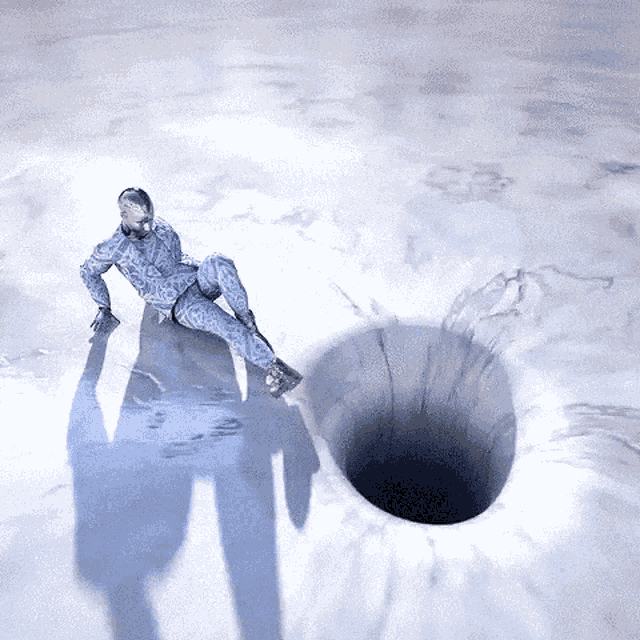
via tenor
Psychology and developmental research have an increasingly clear understanding of why. (This is most likely why you're reading this eighty-seven minute essay.)
Deeper than anxiety, deeper than depression, we seem to share a sense of dread. It's the common lived experience of a lonely void; the embodiment of the term "forever empty." We fear it to be darkness without possibility of light and we're afraid it will consume us if we don't do all we can to keep it at a distance.

crazypost.blogspot
Me: What could possibly go wrong?
Anxiety: I’m glad you asked.
I was born in 1947, the year poet W.H. Auden coined the phrase, "Age of Anxiety." His famous phrase describes precisely how the first thirty-five years of my life felt: always worried, always afraid, always scanning for what terrible thing might happen next.
To paraphrase Rene Descartes, "I (over) think, therefore I am (anxious)."
To say that I was anxious as a child would be an understatement. I've dealt with that same worry as an adult, although the subject matter has changed a thousand times. Mark Twain said it best: "I've lived through some terrible things in my life, some of which actually happened."
Anxiety disorders work that way.
My mother divorced when I was an infant and quickly chose a second husband who was neither faithful to her nor safe for me. She was lost and confused. He was lost and dangerous. Any biological propensity I may have had for anxiety was multiplied by a growing sense of vigilance concerning family dysfunction.
Only years later did it begin to dawn on me why I was always haunted by a sense of dread, and always felt alone. Into my teen years, my questions were always the same: "Why is everything always so dark and frightening? How do I get through this day?"

familymatters.blogspot
After years of this gnawing fear and emptiness, I did what many do. I chose to enter psychotherapy in my early twenties with the hope of bringing an end to the endlessness of it all. Not long after, in an attempt to seal the deal, I entered graduate school to become a psychotherapist myself. (Like many, I lived under the cultural delusion that knowledge would finally solve my pain.)
Along the way, some things changed.
I released anger. I processed fear. I understood more of what had transpired for me as a child. I found some relief.
And along the way, nothing changed.
There remained an underlying experience of negative certainty. There continued to be, throughout each day, intense incredulity about the suffering that seemed to consume so many of us.
Eventually, I found myself working as a clinician with incarcerated women who had been labeled "mentally ill" (most of whom were serving life sentences for murder). Unexpectedly, I began to find my private despair matched by theirs. Though our life circumstances were radically different, as I came to know the stories of these deeply wounded and tender souls, I found myself having one thing in common with their lives, "the meaninglessness of it all." It's as if we were reading the same message from the same book. "So this is life on planet earth: Day to day suffering without hope of change; always concluding at the same endpoint; alone in pain, alone in pain, once again alone in pain."
Oddly, I felt a change beginning that would only make sense years in the future. I began to see that within a sense of shared absence we can, sometimes, experience shared presence.

eightysevenminutes
I began working at a small college and, based on the suggestion of longtime mentor Allan Hunter, started a regular meditation practice. "Kent, there is always more going on than meets the eye. Sit with your hands open and learn to wait. Breathe. Life will open."
Something actually did shift. For several years it was as though my life did open, just a bit. Eventually I quit my job at the college and spent half a year studying with Benedictine monk David Steindl-Rast at a hermitage on the coast of Maine. I counseled terminally ill cancer patients. I lived and worked for almost five years at the Catholic Worker in Los Angeles, finding hidden radiance in the vulnerability, depth, and dignity of the homeless women, men, and children I came to know. In the face of so much suffering, light seemed possible. The opening continued.

Lee Jeffries
But my personal life intervened. As a central relationship in my life continued to fall apart, my life once again closed down. Eventual attempts at intimacy didn't go well. I increasingly felt like a failure at love.
Over the next few years I returned to my well known, deeply internal black hole. What I had hoped was behind me was, with too much familiarity, all around. During this time I also began experiencing chronic pain on the right side of my head. It started one night and regardless of what I did, it wouldn't go away.
I felt increasingly stuck inside myself. I couldn't find a way out.
Knowing of my interest in meditation, a friend introduced me to Robert Aitken, a kind and wise Zen roshi. His approach to Zen was in the tradition that welcomes “kensho,” an experience of enlightenment that often emerges in a sudden burst of insight. Hoping against hope, I returned to a practice of regular meditation with the possibility of changing my life (and stopping the pain).
Not surprisingly, within a few months my new practice simply mirrored my experience of life itself. Sitting alone in silence, I was merely reconfirming my well-worn experience of absence rather than revealing a shift in consciousness. I practiced off and on, but nothing changed.

eightysevenminutes
How could anything change when emptiness, nothingness, and pain were so obviously the underlying truth of everything?
I kept getting up each morning, but with little hope for my future.
Over the next decade, two gifts gradually and inexplicably emerged in my life, surprisingly cross-joined. (Looking back, I must have asked for them. In asking, I had no clue what I actually needed.)