8. Two-Level World
I am deeply grateful to psychoanalyst James Masterson for the following insight, one that has revolutionized my capacity to understand human defenses. Given two options, the second being the black hole, all of us find a way to immediately exit such a dismal possibility. "All alone" vs. defense is never a jump ball. As infants and as adults, we inevitably choose to sidestep utter aloneness.
Attachment research adds a new wrinkle. Our chosen defense inevitably includes some form of relatedness. It's always about finding connection (" . . . grab that cell phone and text someone") instead of plummeting into lonely darkness. Our lives become an endless pursuit of "essential" yet meaningless "stuff," just to stay out of falling into "endless empty."
Two options, and only two options.
Think of it as living in a two-level world. Level Two is the promise of endless absence. Level One is our continual return to negative certainty, a harsh Voice (companion) telling us bad things about ourselves or our future, while also making sure we return to whatever "protective self" game plan seems to keep the terror at bay ("perform better," "keep
quiet," "be smart," "give in," "try harder," "don't stand out").

eightysevenminutes

eightysevenminutes
We dip into Level Two and instantly jump out to our Level One strategy. Continually.
Literally thousands of times each day.
The journey into Level Two is usually so brief, we don't notice it consciously. For example, an important person in your life seems bored during a conversation (glancing at her phone) and you have a millisecond of free fall (again at an unconscious level) into memories of feeling insignificant to your father or mother years before. Utter blackness enters for a micro-second, and then the Voice: "You idiot, say something funny or smart or interesting. Don't be boring! Why are you such a loser?"
Or, you are feeling down and begin to say something about it to a friend. He listens for a minute, then takes over the conversation by describing how this exact same thing recently happened to him. Inside, you fall deeper into a feeling of being alone, then quickly the Voice steps in: "You aren't someone people will ever understand. You're so freaking weird. You'll never belong. Quit trying."
Utterly critical, yet absolutely here with you. Distorted yes; mean, yes. But with you ... for sure.
Psychoanalyst Ronald Fairbairn called this an obstinate attachment: clinging to a negative pattern in our history that we
unconsciously choose to keep repeating, all in the service of staying (or feeling somewhat) connected. When Buddhists speak of giving up "attachments," this is what they're addressing. A connection is a connection is a connection.
What Fairbairn was getting at is that many of us form an attachment or a bond between Level One and Level Two. The Voice may be a distorted bond, but it is a relational bond. It joins our innate need for connection and our procedurally learned sense of futility. This bond shows up as a relationship, a harsh companion that is trying, as Robert Bly describes, to do its best to save us.
Having learned that it can't count on another in moments of vulnerability, the Voice is continually speaking a four-word mantra that will follow us around the rest of our life: "It's up to me."

maddebelle.blogspot
Formed in childhood when we lack perspective, the Voice has no idea how to really be of help. Born within a context of confusion and pain, its attempts to take charge were desperate, flailing stabs in the dark: misguided strategies that sought to give meaning to what felt utterly meaningless. ("If you were just prettier, more intelligent, always upbeat people would like you.") Formed in emptiness, it continually reinforces emptiness.
Let's not forget that our Voice has actually saved us: we actually have something to focus on and a constant companion, relentless yet predictable. Something is better than nothing(ness).
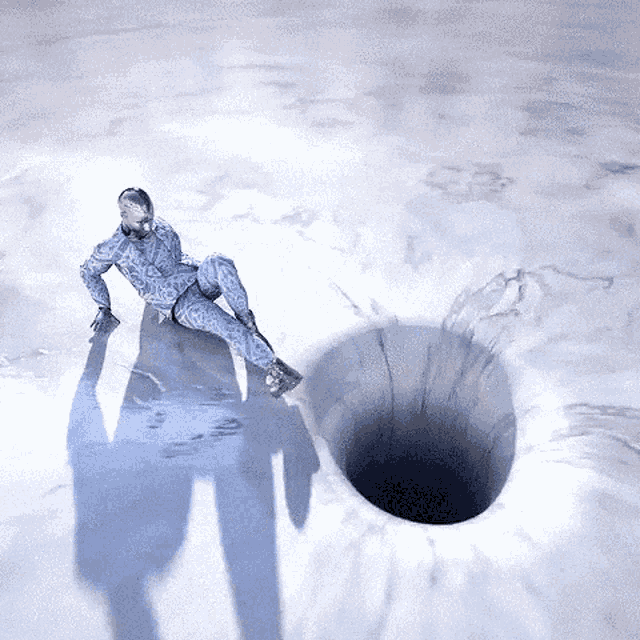
via tenor
And yet, it hasn't saved us. Learned in darkness, this Voice speaks only darkness. So many of us continue to suffer mightily because of this dark bond.

eightysevenminutes
Here is the hope:
We need to realize that a reconfiguration of our brains, one that supports an updated awareness of holding and accepts that new possibility is actually available, requires repeated and genuine experiences of the presence we've been waiting for. Just as importantly, it necessitates our conscious, active participation in no longer dismissing the possibility of a reality (currently unseen) more loving, simple, direct, and generous than the one our procedural certainty tells us is the only option.
Here is where we're about to go:
What if the presence we're all seeking is, well, always present ... hidden-in-plain-sight?
